📗 Exploring Erdnase Book Club: Erdnase Stock Shuffle
Update #16: The Overhand Stock Shuffle

Well, it’s been a while since I updated the Exploring Erdnase Book Club—longer than I’d care to admit, in fact! I haven’t been practising much sleight-of-hand since my parsnip-related accident at Christmas (see Monthly Update #36 of the Ruseletter for the full sorry tale). But now that my thumb is more or less healed, I’ve decided it’s high time we carried on where we left off. The show must go on, and all that!
The next section of The Expert at the Card Table is the Stock Shuffle, and it’s a good one.
What Is a Stock Shuffle?
In Update #15, we explored Erdnase’s methods for secretly arranging desired cards and bringing them to the top or bottom of the deck. But stocking the deck is only half the challenge. Once your cards are in position, you need to be able to convincingly mix the deck while secretly arranging the desired cards into dealing order during the shuffle. That’s precisely what the stock shuffle is designed to do.
Erdnase states the basic method plainly at the outset:
Running up the desired cards in a certain order for dealing, while the deck is being shuffled, can be accomplished to any considerable extent only by the hand shuffle. The method in common use by expert players is to draw the particular cards from the bottom. This method is first explained.
What follows is a description of an overhand shuffle technique for arranging several cards in a specific order while performing an innocent-looking overhand shuffle. Most modern stock shuffles rely on riffle shuffles to achieve this, so Erdnase’s relatively accessible overhand method offers a refreshing change. It’s also worth noting that the author claims this was the technique “in common use by expert players”, which is slightly surprising to me, as you might expect even early twentieth-century card cheats to have favoured stocking cards at the top of the deck rather than working from the bottom (but then, I’m no gambling expert).
The Mechanics
The core action involves drawing cards one at a time from the bottom of the right-hand packet during an otherwise ordinary overhand shuffle:
Seize the deck at ends between the second finger and thumb of the right hand in the usual manner for shuffling, the first finger resting on the side. Run several cards into the left hand, but well down into the palm, so that the second and third fingers protrude to the first joints from underneath. Then when the right hand has made the next downward motion, instead of drawing off the top card with the left thumb press the left second and third fingertips against the bottom card and let it slide into the left hand, drawing it into position on the other cards with the left thumb as the right hand is raised. (See Fig. 32.)
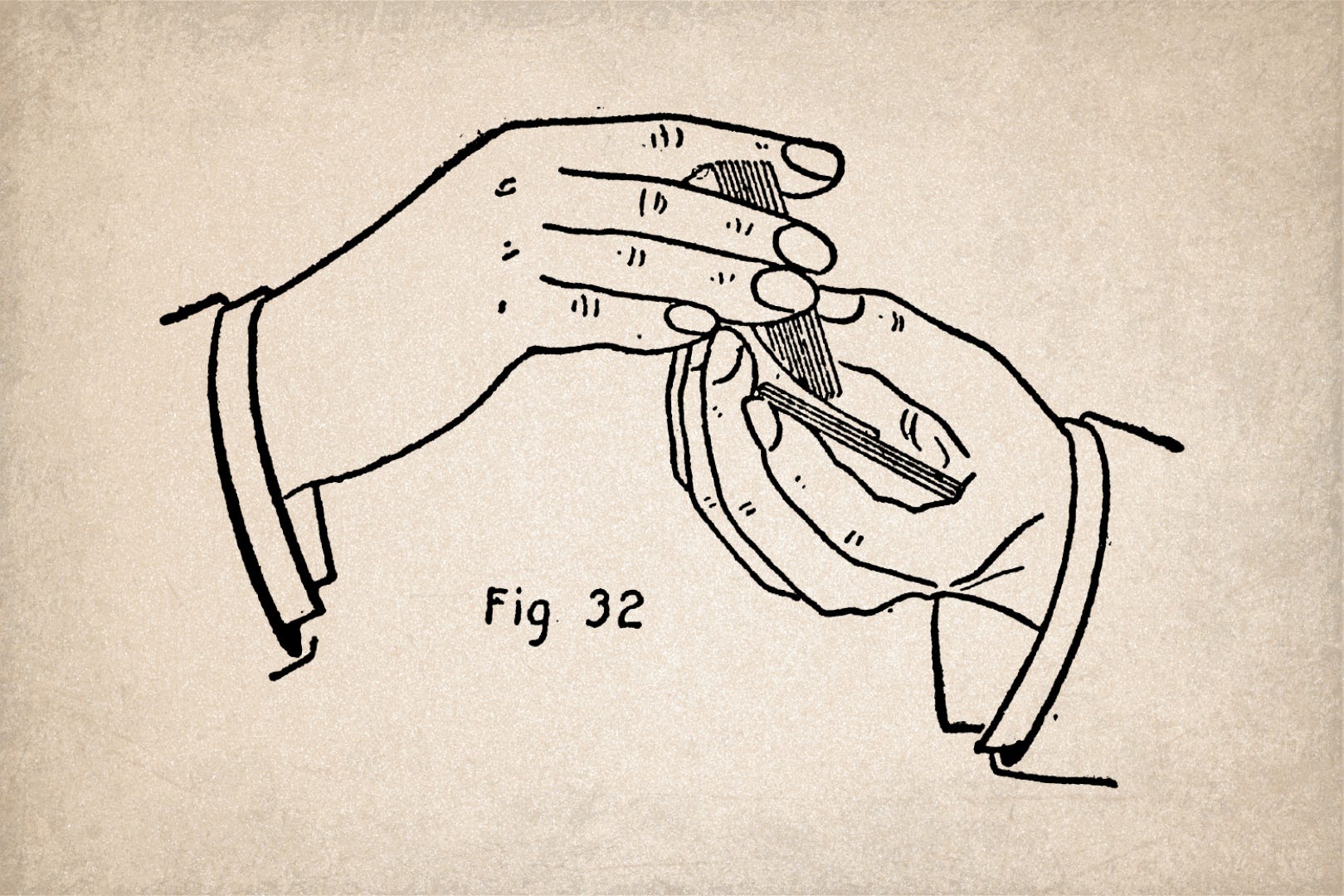
The right hand aids the left fingers by pressing the deck against them and drawing up more horizontally. Then run one card less than the number of players and again draw one from the bottom, and so on until the stock is complete. The left thumb goes through the same motion when the under card is drawn but merely slides across the top card without disturbing it. When the last card has been drawn from the bottom run as many cards as there are players between the dealer and the player for whom the bottom cards are intended, out-jog the next card and shuffle off balance. Then under-cut to out-jog and throw on top.
It’s the left thumb’s motion that makes this technique deceptive. Throughout the shuffle, the thumb must maintain its usual sliding action across the top of the right-hand packet (even when the left fingers draw a card from the bottom), so the external appearance of the shuffle remains completely consistent. Once the required cards are in position, the left-hand packet can be shifted into a more natural overhand-shuffle grip before an injog, a shuffle, and a throw bring the stocked cards to the top of the deck.
Erdnase is candid about the difficulty involved:
This method requires considerable practice, as the knack of drawing the bottom cards, and but one at a time, does not come easily. But when acquired it can be executed with wonderful facility and speed, and the ruse is practically undetectable.
The rhythm of the shuffle is just as important as everything else. Start very slowly, building speed only once you can peel a single card from the bottom without noticeable hesitation or a change in the shuffle’s tempo. Practising with a partial deck, say, thirty-two cards, will help you get a feel for the action before tackling a full pack.
The deeper grip required to reposition the left second and third fingers makes the shuffle feel slightly unnatural, particularly if you’ve been overhand shuffling for years. Erdnase acknowledges this awkwardness and suggests covering it by immediately following the stock shuffle with a blind top stock shuffle.
As someone with longer fingers, I’ve also found I can reduce the need to hold the cards horizontally, which makes the whole thing look a bit more relaxed.
If you have short fingers and have to hold the card more horizontally, you might prefer to substitute the overhand jog control with a simple table cut to the break.
Running Up Two Hands
One of the more impressive things about this technique is that it can be extended to stock two separate hands simultaneously, with one set of cards placed at the top and the other at the bottom before the shuffle begins:
Two or more hands may be run up by this method, if one set is placed at the top and the other at the bottom. The process is to first draw from the top, then from the bottom, in succession, until all the selected cards have been arranged alternately at the bottom of the left-hand packet, then shuffle off balance.
Erdnase illustrates this with a five-handed poker example, working through the precise calculations needed to deal the stocked cards to the correct players. It’s a fascinating glimpse into the methodical thinking required of a serious card sharp. It also strikes me that this technique would lend itself well to a gambling demonstration of some sort.
You can read the complete description in the web version of The Expert at the Card Table:
📗 Read Erdnase 👈
Final Thoughts
What I find most interesting about this section is what it reveals about Erdnase’s priorities. He is not content merely to describe the technique; he is concerned with how it looks, how it sounds, and how it might arouse suspicion if performed carelessly. The observation that there is “a little difference in the sound as the cards fall from the top and bottom” is exactly the kind of detail that makes me believe the author, whoever he was, was an active gambler (not just a magician pretending to be one).
As is often the case, Erdnase’s advice boils down to practice and confidence. A tentative shuffle is a highly suspicious one!
Up Next
Next time, we’ll be moving on to The Erdnase System of Stock Shuffling—a much more detailed and systematic treatment of the subject, covering everything from two-card stocks right up to a twelve-card stock for draw poker and a couple of euchre stocks. It’s a meaty section that should keep us busy for a few weeks.
Until then—keep bucking that tiger! 🐅
Marty